
In the ever-evolving world of dental technology, the choice of materials and equipment plays a crucial role in achieving optimal results. Dental technicians are constantly seeking ways to enhance the precision, efficiency, and esthetics of their work. One significant advancement in this field is the transition from traditional porcelain fused to metal (PFM) casting to lithium disilicate press ingot fabrication. This shift not only improves the quality of prosthetics but also streamlines the production process.
Lithium Disilicate Press Ingot: A Game-Changer
Lithium disilicate has emerged as a preferred material for dental prosthetics due to its superior strength, translucency, and biocompatibility. Unlike PFM restorations, which often require multiple steps and materials, lithium disilicate press ingots offer a more streamlined approach. The use of advanced casting equipment further enhances the precision and efficiency of this method.
Advanced Dental Casting Equipment: Precision Meets Simplicity
One of the most notable advancements in dental lab equipment is the precision casting machine that combines electric and pneumatic systems. This innovative machine is designed specifically for lithium disilicate press ingot applications, offering dental technicians an efficient solution for creating high-quality dental prosthetics.
Key Features of the Precision Casting Machine
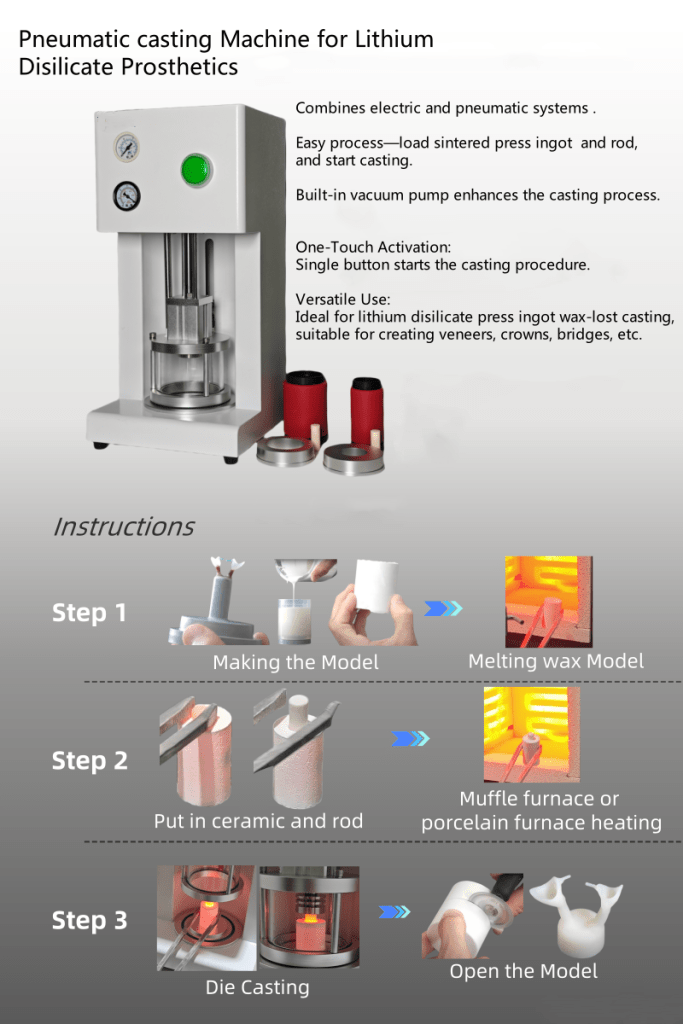
- Simple Operation : With one-touch activation, the entire casting procedure becomes effortless. This reduces the learning curve and minimizes the risk of errors.
- Dual System : The combination of electric controls and pneumatic pressure ensures precise control over the casting process, resulting in consistent and reliable outcomes.
- Enhanced Results : The built-in vacuum pump significantly improves casting quality by ensuring uniform pressure distribution, which is critical for achieving optimal fit and finish.
- Versatile Applications : This machine is not limited to lithium disilicate; it can also be used for veneers, crowns, bridges, and even PEEK dental prosthetics, making it a versatile addition to any dental lab.
- Quick Process : The streamlined workflow allows technicians to load the sintered press ingot and plugger, then start the casting cycle with ease. This reduces overall production time and increases productivity.
How It Works
The casting process using this advanced equipment is both straightforward and precise:
- Setup :
- Create a wax model of the dental prosthetic.
- Attach the sprue to the wax model.
- Place the model in investment material and let it set.
- Heat the investment ring in the furnace according to material requirements.
- Casting Process :
- Select the appropriate ingot shade for the restoration.
- Check the pressure gauges to ensure correct readings.
- Place the ingot and plunger into the investment ring.
- Place the investment ring into the furnace again for crystallization.
- Position the ring in the casting chamber.
- Press the green button to initiate the automatic casting cycle.
- Finishing :
- Allow the ring to cool according to material guidelines.
- Remove the investment material.
- Cut off the sprue using a diamond disc.
- Check the fit on the model and make adjustments if necessary.
- Complete the prosthetic with staining and glazing if required.
Why Choose Lithium Disilicate Press Ingot Over Traditional PFM?
- Strength and Durability : Lithium disilicate offers exceptional strength, making it ideal for long-lasting restorations.
- Translucency and Esthetics : Its natural appearance closely mimics natural tooth structure, providing superior esthetics compared to PFM.
- Simplified Workflow : The press ingot method eliminates the need for multiple layers and firing cycles, reducing complexity and improving efficiency.
- Biocompatibility : Lithium disilicate is highly biocompatible, reducing the risk of adverse reactions in patients.
Looking for Advanced Dental Lab Equipment?
Dental Laboratorio is a great place to explore cutting-edge solutions for your dental lab needs. Their precision casting machines, like the one described above, combine innovation with practicality, ensuring that dental technicians can deliver top-tier prosthetics with ease.
Conclusion
The transition from traditional porcelain fused to metal casting to lithium disilicate press ingot fabrication represents a significant leap forward in dental technology. Coupled with advanced dental casting equipment, this method offers unparalleled precision, efficiency, and esthetics. By embracing these innovations, dental technicians can elevate their craft and provide patients with restorations that are both functional and beautiful.
For those looking to upgrade their dental lab supplies and equipment, investing in state-of-the-art tools like the precision casting machine is a wise decision. It not only enhances productivity but also ensures that every prosthetic meets the highest standards of quality and patient satisfaction.

 patient beds online